Showing posts with label Section 1: The Nature and Variety of Living Organisms. Show all posts

Saturday, June 24, 2017

1.1: Understand that living Organisms share the following Characteristics:

LETTER
DESCRIPTION
M - MOVEMENT
All Living Organisms Move
R - RESPIRATION
All Living Organisms will Inhale and Exhale
S - SENSITIVITY
All Living Organisms will Respond to Stimuli
G - GROWTH
All Living Organisms will Grow
R - REPRODUCTION
All Living Organisms will Reproduce
E - EXCRETION
All Living Organisms will Excrete Waste
N - NUTRITION
All Living Organisms Require Nutrition

1.2: Describe the common features shared by organisms within the following main groups: Plants, Animals, Fungi, Bacteria, Proctists and Viruses

GROUPS OF ORGANISMS
small.pngPLANTS:
  • Multicellular Organisms
  • Stores Carbohydrates as Starch
  • Cells contain Chloroplasts; carries out
          Photosynthesis
  • Cell walls are made of Cellulose
  • Example: Herbaceous Legume
ANIMALS
  • small-1.pngMulticellular Organisms
  • Stores Carbohydrates as Glycogen
  • Cells DO NOT contain Chloroplasts; cannot carry out photosynthesis
  • No Cell walls
  • Nervous Coordination: Can move from one place to another
  • Example: Mammals and Insects

large-1.pngFUNGI
  • Both Multicellular and Unicellular
  • Stores Carbohydrates as Glycogen
  • Cell walls are made of Chitin
  • DO NOT carry out Photosynthesis
  • Organised into a Mycelium: Thread-like structure called Hyphae, which contains many Nuclei
  • They feed by Extracellular Secretion: Releases digestive enzymes onto food and absorb organic products ( saprotrophic nutrition )
  • Example: Mucor / Yeast

large-2.pngBACTERIA
  • Unicellular Organisms
  • Lack in Nuclei’s so has circular chromosomes of DNA called Plasmids
  • Has Cell wall, Cell membrane, Cytoplasm
  • SOME can carry out Photosynthesis
  • Feeds by eating living or dead living Organisms
  • Example: Lactobacillus Bulgaricus (Yoghurt Production)

PROCTISTS
  • 305dd0d8b7394821f7f29f368a7ae6cd.gifMicroscopic Unicellular Organisms
  • Example: Animals: Amoeba
                           Plants: Chlorella


VIRSUS
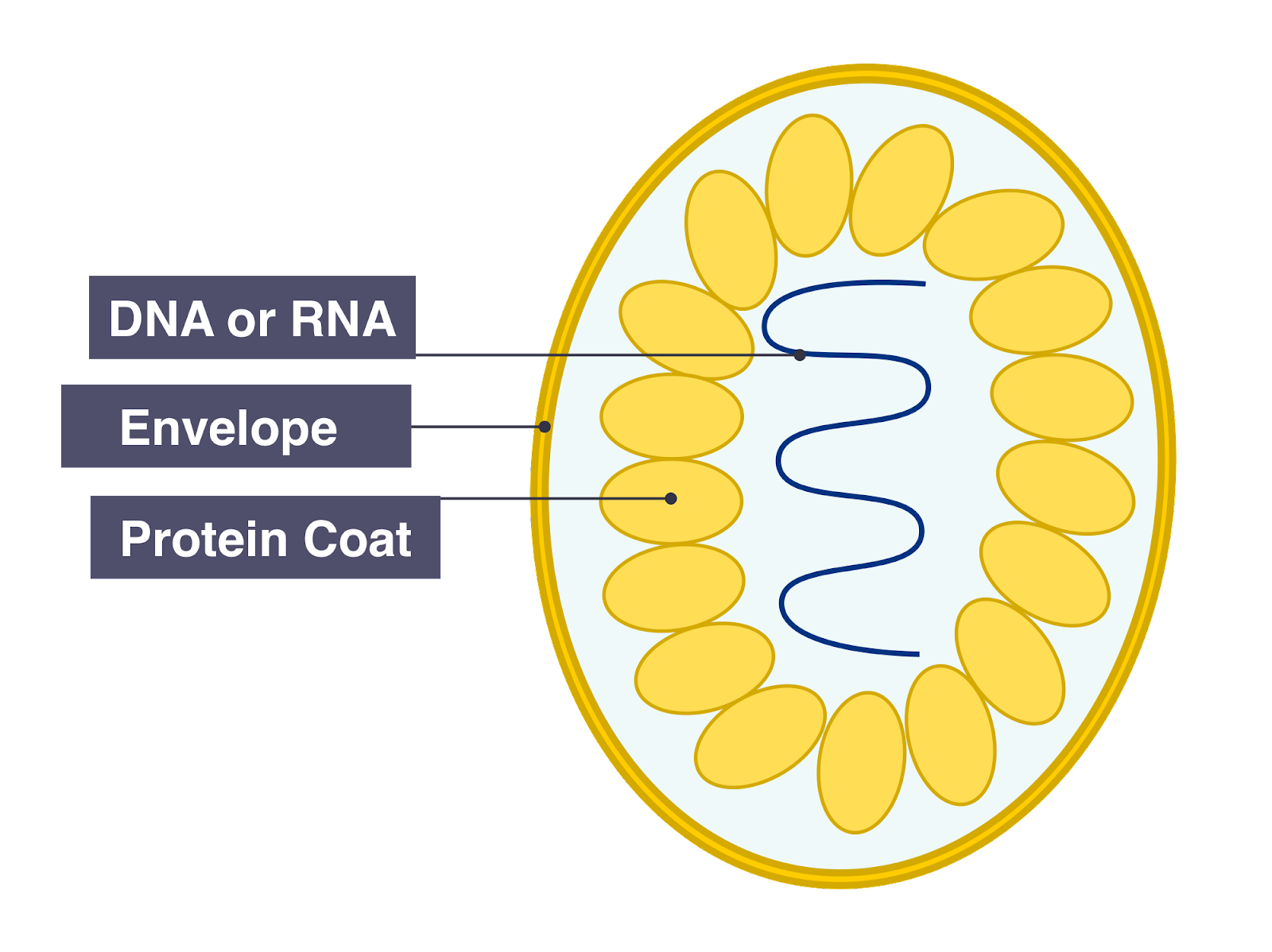
  • Simple_diagram_of_virus_(en).svg.pngSmall Particles ( smaller than Bacteria )
  • Parasitic: can only reproduce in living Organisms
  • They only reproduce infect every type of living Organisms
  • They have a wide variety of shapes and sizes
  • No Cellular structure
  • Has protein coat
  • Contains one type of Nucleic Acid ( RNA or DNA )
  • Example: Tobacco Mosaic Virus / HIV
                           Plants: Chlorella

1.3: Recall the term ‘Pathogen’ and know that Pathogens may be Fungi, Bacteria, Protoctists or Viruses

PATHOGENS: Micro-organisms that causes Diseases

COMMON PATHOGENS
large-1.pngFUNGI
  • Both Multicellular and Unicellular
  • Stores Carbohydrates as Glycogen
  • Cell walls are made of Chitin
  • DO NOT carry out Photosynthesis
  • Organised into a Mycelium: Thread-like structure called Hyphae, which contains many Nuclei
  • They feed by Extracellular Secretion: Releases digestive enzymes onto food and absorb organic products ( saprotrophic nutrition )
  • Example: Mucor / Yeast

large-2.pngBACTERIA
  • Unicellular Organisms
  • Lack in Nuclei’s so has circular chromosomes of DNA called Plasmids
  • Has Cell wall, Cell membrane, Cytoplasm
  • SOME can carry out Photosynthesis
  • Feeds by eating living or dead living Organisms
  • Example: Lactobacillus Bulgaricus (Yoghurt Production)

PROCTISTS
  • 305dd0d8b7394821f7f29f368a7ae6cd.gifMicroscopic Unicellular Organisms
  • Example: Animals: Amoeba
                           Plants: Chlorella


Simple_diagram_of_virus_(en).svg.pngVIRSUS
  • Small Particles ( smaller than Bacteria )
  • Parasitic: can only reproduce in living Organisms
  • They only reproduce infect every type of living Organisms
  • They have a wide variety of shapes and sizes
  • No Cellular structure
  • Has protein coat
  • Contains one type of Nucleic Acid ( RNA or DNA )
  • Example: Tobacco Mosaic Virus / HIV
                         Plants: Chlorella