Showing posts with label Section 2: Structures and Functions in Living Organisms. Show all posts

Saturday, June 24, 2017

2.1: Describe the levels of Organisation within Organisms: Organelles, Cells, Tissues, Organs and Systems

LEVELS OF ORGANISATION:

LEVEL
DESCRIPTION
ORGANELLES
Cell Structures Specialized with a Specific fFunction
CELLS
Basic Functional and Structural Units in a Living Organism
TISSUES
Made from Same Cells carrying out the Same Function
ORGANS
Made from Similar Tissues carrying out the Same Function
SYSTEMS
Made from Organs carrying out Body Function

2.2: Describe Cell Structures, including the Nucleus, Cytoplasm, Cell Membrane, Cell Wall, Chloroplast and Vacuole

CELL STRUCTURE:

CELL STRUCTURE
DESCRIPTION
NUCLEUS
Membrane Organelle that contains Genetic Material
CYTOPLASM
Material within a Living Cell, Excluding the Nucleus
CELL MEMBRANE
Semi-Partially Permeable Membrane surrounding Cytoplasm of Cell
CELL WALL
A Membrane of the Cell that forms external to the Cell Membrane which is made from Cellulose
CHLOROPLAST
Plastid in Green Plant cells, which contains Chlorophyll
VACUOLE
Space in the Cytoplasm of a Cell, contains fluid

2.4: Compare Structures of Plant and Animal cells

STRUCTURE OF PLANT AND ANIMAL CELL:

PLANT CELL
ANIMAL CELL
Fixed Shape
No Fixed Shape
Large Vacuole
Little or no Vacuole
Cell Wall
No Cell Wall
Contains Chloroplasts (can conduct Photosynthesis)
Does not contain Chloroplasts (No Photosynthesis)

2.3: Describe the Functions of the Nucleus, Cytoplasm, Cell Membrane, Cell Wall, Chloroplast and Vacuole

FUNCTION:

CELL STRUCTURE
FUNCTION
NUCLEUS
Contains Genetic Material
CYTOPLASM
Where Chemical Reactions take place, Keeps Organelles in place and fills the Cell
CELL MEMBRANE
Controls what Substances goes in and out of the Cell
CELL WALL
Holds the Cellular Structure
CHLOROPLAST
Allows Photosynthesis to take place
VACUOLE
Holds Fluid and Cellular Waste

2.6: Describe the structure of Carbohydrates, Proteins and Lipids as large molecules made up from smaller basic units: Starch and Glycogen from Simple Sugar; Protein from Amino Acids; Lipid from Fatty Acids and Glycerol

STRUCTURE: 

MOLECULE
STRUCTURE
STARCH AND GLYCOGEN
Made from Simple Sugars
PROTEIN
Amino Acids
LIPID
Fatty Acids and Glycerol

2.5: Identify the chemical elements present in Carbohydrates, Proteins and Lipids (Fats and Oils)

CHEMICAL ELEMENTS:

MOLECULE
CHEMICAL ELEMENTS
CARBOHYDRATE
Carbon, Oxygen and Hydrogen
PROTEIN
Carbon, Oxygen, Hydrogen, Sulfur, Nitrogen and Phosphorous
LIPIDS
Carbon, Oxygen and Hydrogen

2.7: Describe the test for Glucose and Starch

TEST FOR GLUCOSE:

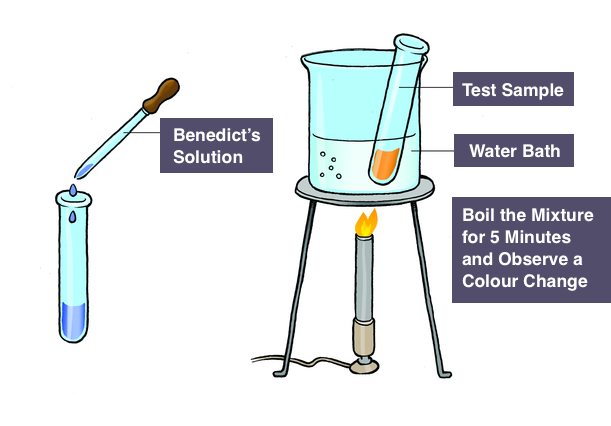
TEST FOR GLUCOSE
7529917e3983e4aa8e879d2336adfe86.png
Diagram Showing the Test for Glucose using Benedict’s Solution
METHOD:

  • Add Drops of Benedict's Solution into Sample Solution in Test Tube
  • Heat at 60 - 70 °C in Water Bath for 5 Minutes
  • Take Test Tube out of Water Bath and Record the Colour

RESULT:

  • If Glucose is Present, Solution should Turn Brick Red
  • If Glucose is Not Present, Solution should Stay Blue

 s


TEST FOR STARCH:

TEST FOR STARCH
Diagram Showing the Test for Starch using Iodine Solution
METHOD:

  • Take Sample of Solution and Use Pipette to Put it into Wells or on Tile
  • Add Drops of Iodine Solution and Leave it for 1 Minute (To Allow Reaction to Take Place)

RESULT:

  • If Starch is Present, Solution should Turn Blue - Black
  • If Starch is Not Present, Solution Should Stay Brown

2.8: Understand the role of Enzymes as Biological Catalyst in Metabolic Reactions

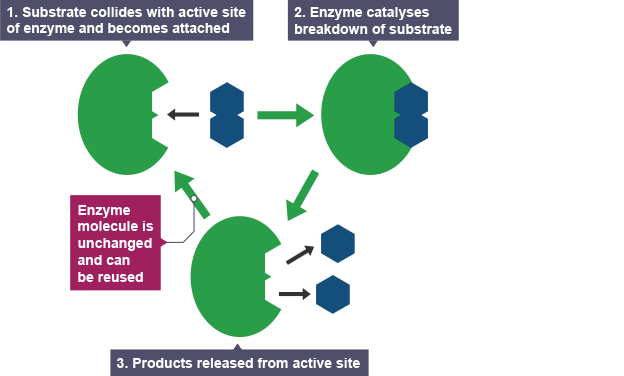
ENZYMES: Enzymes are biological catalyst in Metabolic Reactions (digestion) as they allow Substrates to bind onto their active site, breaking them down into products

Diagram:


COMMON ENZYMES:

ENZYME
REACTION
AMYLASE / MALTASE
Starch Glucose
PROTEASE
Protein Amino Acids
LIPASE
Lipids Fatty Acids & Glycerol

2.9: Understand how the functioning of Enzymes can be affected by the changes in Temperature, including changes due to Change in Active Site

TEMPERATURE:
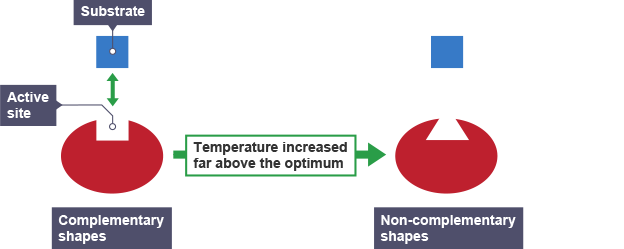
  • In Higher Temperatures, Enzyme Activity increases as it is closer to Optimum Temperature
  • Enzymes increase in Kinetic Energy, More successful and frequent Collisions
  • Rate of Metabolic reactions increases

IF TEMPERATURE IS TOO HIGH (Above Optimum Temperature):
  • If Temperature is too high and is above Optimum Temperature, Enzymes will denature
  • High Temperature destroys shape of Active Site, Substrate cannot fit in
  • Metabolic reactions cannot take place

Diagram:
                                

2.10: Understand how the functioning of Enzymes can be affected by the changes in Active Site caused by changes in pH

pH (Concentration):
  • In High pH, Enzyme Activity increases as it maintains shape of Active Site so Substrate can fit in, Metabolic reactions can take place
  • Rate of Metabolic reactions increases

IF pH IS TOO HIGH (Above Optimum pH):
  • If pH is too high and is above Optimum pH, Enzymes will denature
  • High pH destroys shape of Active Site, Substrate cannot fit in
  • Metabolic reactions cannot take place

Diagram:
                             large.png


2.11: Describe Experiments to Investigate How Enzyme Activity can be Affected by Changes in Temperature

INVESTIGATING EFFECT OF TEMPERATURE ON ENZYME ACTIVITY
 Amylase.jpg
Diagram Showing the Spots of Starch and Amylase in Wells
METHOD:

  • Starch Solution is heated to set temperature
  • Amylase is added
  • Iodine is added
  • Every minute, droplets of solution is added into wells
  • Time is measured until Iodine to stops turning Blue Black
  • Time obtained is compared to that of different Temperatures

RESULT:

  • When Iodine stops turning Blue Black, this means that Starch is not present
  • Enzyme Amylase has broken down Starch into Glucose
  • This shows how Enzyme Activity is affected by Temperature

2.12 Understand Definitions of Diffusion, Ssmosis and Active Transport

DEFINITION:

TERM
DEFINITION
DIFFUSION
Net Movement of Particles Down the Concentration Gradient (High Concentration to Low Concentration)
OSMOSIS
Net Movement of Water Particles Down the Concentration Gradient (High Concentration to Low Concentration) through a Partially Permeable Membrane
ACTIVE TRANSPORT
Net Movement of Molecules and Substances Against the Concentration Gradient (Low Concentration to High Concentration) using Energy in the form of ATP

2.13: Understand that movement of Substances into and out of cells can be by Diffusion, Osmosis and Active Transport

EXPLANATION:

TERM
MOVEMENT
DIFFUSION
- Particles will move until equilibrium is met
OSMOSIS
- Partially Permeable Membrane only allows small enough    
 Water Particles to move through until Water Equilibrium is
 Met
ACTIVE TRANSPORT
- Protein Carriers will pick up Substances and Molecules
 and use Energy in the form of ATP (From Mitochondria) to
 move them against the Concentration Gradient