Showing posts with label c) Cycles within Ecosystems. Show all posts

Saturday, June 24, 2017

4.10: Describe the Stages in the Nitrogen Cycle, Including the Roles of Nitrogen Fixing Bacteria, Decomposers, Nitrifying Bacteria and Denitrifying Bacteria (Specific Names of Bacteria are Not Required)

NITROGEN CYCLE: Describes the Movement of Nitrogen Compounds in the Environment

THE NITROGEN CYCLE
Diagram Showing the Nitrogen Cycle
EXPLANATION:

  1. NITROGEN FIXATION
  • Nitrogen Gas in the Atmosphere is Too Unreactive to be Used Directly so Needs to be Converted into Soluble Ions
  • Nitrogen Fixing Bacteria in Root Nodules of Legumes will Convert Nitrogen Gas into Nitrates for Use
  • Lightning will Convert Nitrogen Gas into Nitrates
  • Haber Process will Convert Nitrogen Gas into Ammonia, in which Nitrifying Bacteria will Convert into Nitrites, then Nitrates

  1. ABSORPTION BY PLANTS
  • Plants will Absorb Nitrates through the Roots by Active Transport
  • Nitrate Ions Help Produce Amino Acids which will become Protein, Becoming Part of Plants Biomass

  1. MOVING ALONG FOOD CHAINS
  • Animals will Eat Plants and Nitrogen from the Plant’s Protein will become Protein in the Animal
  • Nitrogen is also Passed from One Animal to Another by Feeding

  1. DEATH OF ORGANISMS
  • Decomposers (Bacteria and Fungi) will Break Down urea, Egested Material and Dead Bodies and Nitrogen Compounds will be Returned to the Soil as Ammonium Ions
  • Nitrifying Bacteria will Convert Ammonium Ions into Nitrites, then Nitrates for Plants to Absorb

  1. DENITRIFICATION
  • Denitrifying Bacteria in the Soil will Break Down Nitrates and Return Nitrogen Gas into the Air
  • This Occurs in Waterlogged Soil so can be Prevented by Reducing Drainage

4.9: Describe the Stages in the Carbon Cycle, including Respiration, Photosynthesis, Decomposition and Combustion

CARBON CYCLE: Describes the Movement of Carbon Molecules in the Environment

THE CARBON CYCLE
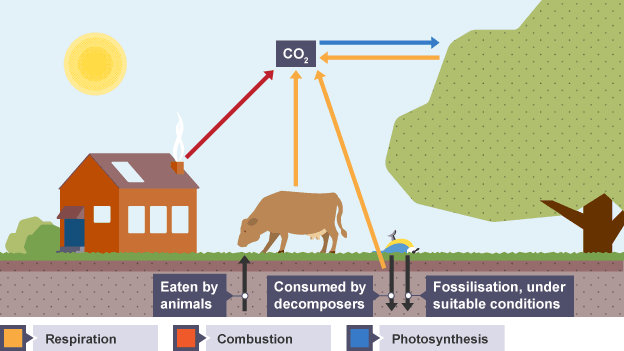
Diagram Showing the Carbon Cycle
EXPLANATION:

  1. RESPIRATION
  • All Living Organisms will Respire Aerobically and Release Carbon Dioxide into the Atmosphere as Organic Compounds that are Broken Down to Release Energy

  1. PHOTOSYNTHESIS
  • Photosynthesis Fixes Carbon Atoms from Atmospheric Carbon Dioxide into Organic Molecules and Becomes Part of Complex Carbon Compounds in Plants

  1. DECOMPOSITION
  • Dead Organisms are Broken Down by Decomposers and Carbon in their Bodies are Returned to the Atmosphere as Carbon Dioxide

  1. COMBUSTION
  • If Decomposition is Blocked, Plant and Animal Material are Available as Fossil Fuels After a Long Period of Time
  • Combustion of Fossil Fuels Releases Carbon Dioxide Back into the Atmosphere

4.8: Describe the Stages in the Water Cycle, including Evaporation, Transpiration, Condensation and Precipitation

WATER CYCLE: Describes How Water Moves on, Above and Below the Earth’s Surface

THE WATER CYCLE
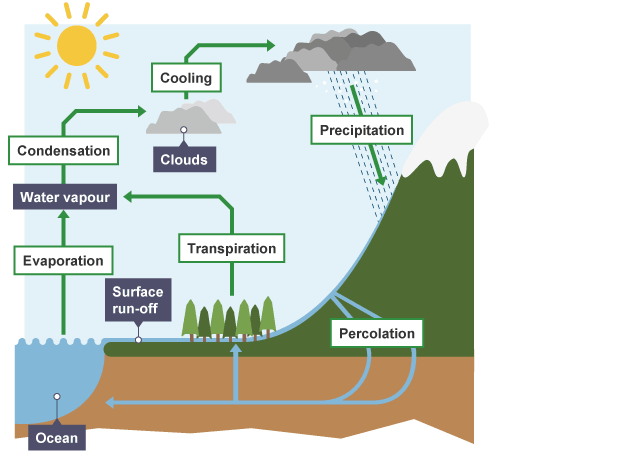
Diagram Showing the Water Cycle
EXPLANATION:

  1. EVAPORATION
  • The Sun will Emit Energy that will Heat the Earth’s Surfaces and cause Water Vapours to Evaporate from Oceans, Rivers and Lakes

  1. TRANSPIRATION
  • Transpiration from PLants Releases Water Vapour into the Air and will Evaporate

  1. CONDENSATION
  • As Moist Air Rises and Cools Down, Water Vapours will Condense to Form Liquid Water that will Produce Clouds

  1. PRECIPITATION
  • As Water Droplets in Clouds become Bigger and Heavier, they will Fall as Rain, Snow and Sleet