Showing posts with label c) Genetic Modification (Genetic Engineering). Show all posts

Saturday, June 24, 2017

5.12: Describe the Use of Restriction Enzymes to Cut DNA at Specific Sites and Ligase Enzymes to Join Pieces of DNA Together

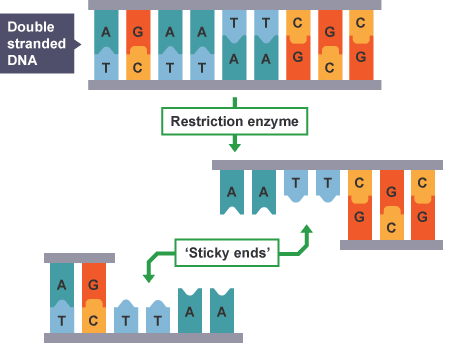
RESTRICTION ENZYME: Enzymes Used to Cut Out the Gene from an Organism

RESTRICTION ENZYME
919ad613beb8fe3abca51b5f283fa81f40512166.gif
Diagram Showing the Action of Sticky Ends
EXPLANATION:

  • Restriction Enzymes Cut Across the Double Strands at Two Different Places, the Place where they Cut Across the DNA is called the Sticky End
  • Restriction Enzymes can be used to Cut Out Specific Genes and also Cut Open Places in the Plasmid DNA of a Bacteria
  • The Sticky Ends will Ensure that the Cut Out Gene (Target Gene) is Able to Fit Exactly in the Plasmid DNA of a Bacteria


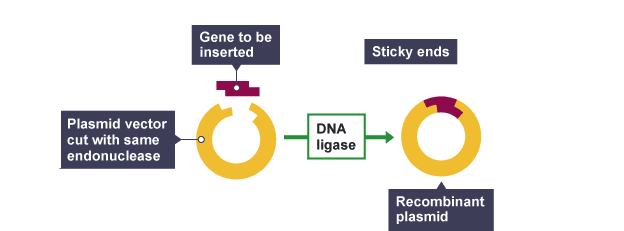
LIGASE ENZYME: Enzymes Used to Stick the Gene into the DNA of another Organism

LIGASE ENZYME
Diagram Showing the Action of Ligase Enzymes
EXPLANATION:

  • Ligase is a DNA - Joining Enzyme
  • If Two Pieces of DNA have Matching Ends (Sticky Ends from Restriction Enzymes), Ligase will Link them to Form a Single, Unbroken Molecule of DNA
  • This Allows the Cut Out Gene (Target Gene) to be Inserted and Joined into the Plasmid DNA of a Bacteria

5.13: Describe How Plasmids and Viruses can Act as Vectors, which Take Up Pieces of DNA, then Insert this Recombinant DNA into Other Cells

RECOMBINANT DNA: DNA that is Artificially Formed by Combining Sections of DNA from Different Organisms

VECTOR: Vehicles that Carry Recombinant DNA and Inserts them into Other Cells

VECTORS
Diagram Showing the Two Different Types of Vectors
PLASMIDS:

  • Ligase Enzyme Allows the Cut Out Gene (Target Gene) to be Inserted and Joined into the Plasmid DNA of a Bacteria, Forming a Recombinant DNA
  • Recombinant DNA is Inserted into a Bacterial Cell
  • Plasmids will Transfer Recombinant DNA to Other Bacteria when it Reproduces by Binary Fusion

VIRUS:
  • Ligase Enzyme Allows the Cut Out Gene (Target Gene) to be Inserted and Joined into the Plasmid DNA of a Bacteria, Forming a Recombinant DNA
  • Recombinant DNA is Inserted into a Virus
  • Viruses will Carry Recombinant DNA and Infect Organisms that it Comes into Contact with, Inserting Recombinant DNA into Cell

5.14: Understand that Large Amounts of Human Insulin can be Manufactured from Genetically Modified Bacteria that are Grown in a Fermenter

INSULIN: Lowers Blood Glucose Levels by Turning Glucose in the Blood to Glycogen (insoluble) To be Stored in Muscles and the Liver

HOW INSULIN IS MANUFACTURED

MANUFACTURE OF INSULIN
Diagram Showing the Manufacture of Insulin
EXPLANATION:

  • Restriction Enzyme is Used to Cut Out Insulin Gene (Gene for Making Insulin) from Human DNA
  • Restriction Enzyme is Used to Cut Open Plasmid DNA of Bacteria
  • Insulin Gene is Inserted into Plasmid DNA of Bacteria and is Joined Together using Ligase Enzyme
  • Insulin Gene is Now Recombinant and Inserted into a Bacterial Cell (Vector)
  • Transgenic Bacteria is Complete (Contains Genes from Different Species) and is Grown in a Fermenter to Reproduce and Duplicate

USES OF MANUFACTURED INSULIN:

  • Helps those who has Diabetes as their Body Does Not Produce Enough Insulin but has High Blood Glucose Levels, so Not All Glucose is Reabsorbed
  • Insulin can be Injected will Help Lower Blood Glucose Levels by Converting Glucose into Glycogen (Insoluble) which is Stored in the Muscles and the Liver

5.15: Evaluate the Potential for using Genetically Modified Plants to Improve Food Production (Illustrated by Plants with Improved Resistance to Pests)

GENETICALLY MODIFIED PLANTS: Plants which have had DNA from a Different Species or a Different Individual Inserted into their Genome

POTENTIAL FOR USING GENETICALLY MODIFIED PLANTS

ADVANTAGE
DISADVANTAGE
Can be Genetically Modified to get Desired Characteristics, E.g Rich in Vitamins and Nutrients
Not Scientifically Proven to be Safe for Human Consumption
Increases Chances of Survival - Resistant to Pests and Diseases
May cause Unexpected Allergies
Greater Yield - Large Number of Plants can be produced
Irreversible
Any Time of the Year - Can be Genetically Modified for Specific Environment
Natural Food Chain Disrupted

5.16: Understand that the Term ‘Transgenic’ Means the Transfer of Genetic Material from One Species to a Different Species

TRANSGENIC: Transfer of Genetic Material from One Species to a Different Species (Contains Genes from Different Species of Organisms)

Example:
                                

Bacteria Used to Carry Recombinant Insulin Gene is Transgenic as it Contains Genetic Material from a Human Cell and a Bacteria Cell