Showing posts with label Humans. Show all posts

Saturday, June 24, 2017

2.23: Understand that a Balanced Diet Includes appropriate Proportions of Carbohydrate, Protein, Lipid, Vitamins, Minerals, Water and Dietary Fibre

IMPORTANCE:

  • Humans need to Eat a Balanced Diet to Maintain a Good Health
  • Each Component of the Diet is Important for different reasons, it is important to consume equal amounts of all

 s

IMPORTANT DIETS CONSIST OF:

DIET
CARBOHYDRATE
LIPIDS
WATER
PROTEIN
DIETARY FIBRE

VITAMINS
MINERALS

2.25: Understand that Energy Requirements vary with Activity Levels, Age and Pregnancy

FACTORS THAT AFFECT ENERGY REQUIREMENTS:

FACTOR
EXPLANATION
AGE
The Amount of Energy requirements that Young People need increases towards adulthood as this energy is needed for growth. E.g, Muscle development
ACTIVITY LEVELS
The More Active you are, the more Energy you will require to keep your body moving E.g, If you Exercise, More Muscle Contractions, More Respirations, More Energy Required
PREGNANCY

During Pregnancy, the Energy Requirements will increase as Energy is needed to support the growth of the developing fetus, as well as the Larger Mass that the Mother needs to carry around, Requiring More Energy. E.g, It is important for Mothers to consume Protein for the Growth and Repair of the baby

2.24: Identify Sources and Describe Functions of Carbohydrate, Protein, Lipid (Fats and Oils), Vitamins A, C and D, and the Mineral Ions Calcium and Iron, Water and Dietary Fibre as Components of the Diet

DIET
FUNCTION
CARBOHYDRATE
Direct Energy
SOURCE: Meat, Starch
PROTEIN
Growth and Repair
DEFICIENCY: Marasmus - Poor Growth
SOURCE: Meat
VITAMIN A
Healthy Eyesight
DEFICIENCY: Night Blindness
SOURCE: Carrots
VITAMIN C
Heal Wounds and Rebuild Tissue
DEFICIENCY: Scurvy - Bleeding Gums
SOURCE: Lemon
VITAMIN D
Strengthen Teeth and Bones
DEFICIENCY: Rickets - Curvature of Bones
SOURCE: Margarine
LIPID
Insulation and Energy Storage
SOURCE: Meat
DIETARY FIBRE
Lower Cholesterol
DEFICIENCY: Constipation
SOURCE: Vegetables
CALCIUM
Strengthen Teeth and Bones
DEFICIENCY: Rickets - Curvature of Bones
SOURCE: Milk
IRON
Promote Haemoglobin
DEFICIENCY: Anaemia - Poor Oxygen Transport
SOURCE: Meat
WATER
Chemical Reactions to take place
SOURCE: Water

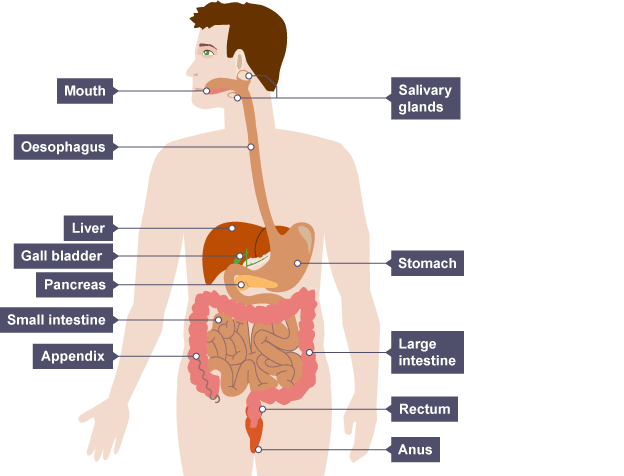
2.26: Describe the Structures of the Human Alimentary Canal and Describe the Functions of the Mouth, Oesophagus, Stomach, Small Intestine, Large Intestine and Pancreas

ALIMENTARY CANAL: Passage in Which Food Passes Through the Body from the Mouth to the Anus

Diagram:


STRUCTURE OF ALIMENTARY CANAL:

STRUCTURE
FUNCTION
MOUTH
  • The Mouth is where Mechanical Digestion Takes Place
  • Large Food is turned into a Food Bolus with Larger Surface Area to Volume Ratio so Enzymes in Saliva called Amylase, can break down Starch into Glucose
  • Food Bolus is lubricated in Saliva so it can be Swallowed Easily
OESOPHAGUS
  • Tube that Connects the Mouth to the Stomach
  • Where the Food Bolus goes after being swallowed
  • Wave - like Contractions will take place to push the Food Bolus Down without the Force of Gravity
STOMACH
  • Where food is Churned Mechanically while Enzymes do so Chemically
  • Hydrochloric Acid will be present to allow Optimum pH so Increases Enzyme Activity and the Rate of Metabolic Reactions
SMALL INTESTINE
  • Lined with Villi to Absorb Digested Soluble Molecules into the Circulatory System for Use
LARGE INTESTINE
  • Water is Absorbed from Undigested Food to produce faeces (Stored in the Rectum and Removed through the Anus)
PANCREAS
  • Produce Enzymes; Amylase, Protease and Lipase
  • Secretes Enzymes into the Stomach and Small Intestine for Digestion

2.28: Explain How and Why Food is Moved through the Gut by Peristalsis

PERISTALSIS: Wavelike Contractions that Push the Food Bolus Down the Oesophagus

PERISTALSIS
 
Diagram Showing the Process of Peristalsis
PERISTALSIS OCCURS BY THE CONTRACTION OF TWO MUSCLES:

  • Circular Muscle - Contracts to Change the Radius of the Oesophagus
  • Longitudinal Muscle - Contracts to Change the Length of the Oesophagus
  • Together, they create Wave - Like Contractions that will Push the Food Bolus Down

PURPOSE OF PERISTALSIS:

  • Push Food Down without the Force of Gravity
  • Large Food Boluses Do Not get Stuck

2.27: Understand the Process of Ingestion, Digestion, Absorption, Assimilation and Egestion

TERM
DEFINITION
INGESTION
Taking in of Food (Eating)
DIGESTION
Breaking Down Large Insoluble Molecules into Small Soluble Molecules
ABSORPTION
Removing Digested Soluble Molecules from the Gut and Entering Circulatory System
ASSIMILATION
Cells of Tissue Absorbs Digested Soluble Molecules for Use
EGESTION
Removal of Undigested Waste E.g Faeces
EXCRETION
Removal of Waste of Metabolism E.g Sweat

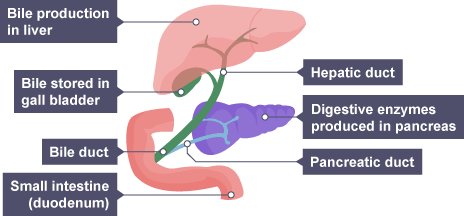
2.30: Understand that Bile is Produced by the Liver and Stored in the Gall Bladder, and Understand the Role of Bile in Neutralising Stomach Acid and Emulsifying Lipids

BILE: Bile is an Alkaline Substance Produced in the Liver and Stored in the Gall Bladder

FUNCTIONS OF BILE:

FUNCTIONS OF BILE
 
Diagram showing Where Bile is Produced
FUNCTIONS:

  1. EMULSIFYING LIPIDS
  • Breaks down Lipids into Smaller Molecules with Larger Surface Area to Volume Ratio so Lipase can Break them Down Faster into Fatty Acids and Glycerol (This Process Usually takes a Long Time)

    2. NEUTRALISING STOMACH ACID
  • Enzymes in the Small Intestine work Best at the Optimum pH of 8-14 (Alkaline Conditions), But the Food that is Churned in the Stomach by Hydrochloric Acid is Acidic
  • Bile Neutralises Hydrochloric Acid so allows an Alkaline Environment for Enzymes to work at their Optimum pH, Rate of Metabolic Reactions Increases

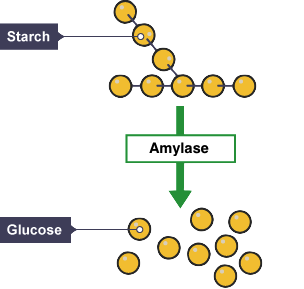
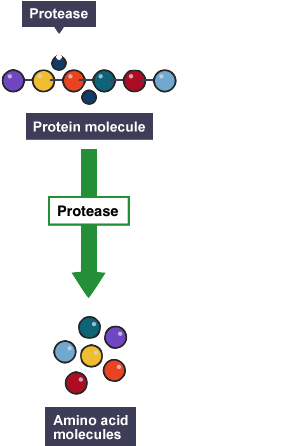
2.29: Understand the Role of Digestive Enzymes, to Include the Digestion of Starch to Glucose by Amylase and Maltase, the Digestion of Proteins to Amino Acids y Proteases and the Digestion of Lipids to Fatty Acids and Glycerol by Lipases


ENZYME
REACTION
MOLECULE
AMYLASE / MALTASE
Starch Glucose
PROTEASE
Protein Amino Acids
LIPASE
Lipids Fatty Acids & Glycerol

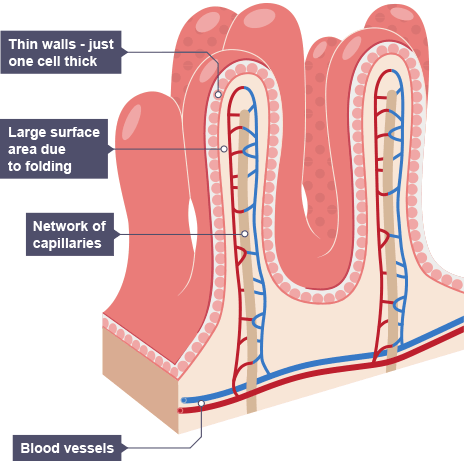
2.31: Describe the Structure of a Villus and Explain how this Helps Absorption of the Products of Digestion in the Small Intestine

VILLUS: The Inside of the Small Intestine is lined with villi and are folded to increase the Surface Area to Volume Ratio

  • Their function is to Absorb Digested Soluble Molecules into the Circulatory System for Use, Hence why they contain Blood Capillaries to carry the Molecules away for Assimilation through the Hepatic Portal Vein


Diagram:


ADAPTATIONS:

ADAPTATION
FUNCTION
THIN CELL WALLS
Thin Cell Walls (One Cell Thick) so the Distance of Diffusion of Digested Soluble Molecules is Short, Allowing the Efficient Rate of Diffusion
LARGE SURFACE AREA TO VOLUME RATIO
Villi is Folded to Increase the Surface Area to Volume Ratio so More Molecules can Diffuse into the Villi at Once, Increasing the Rate of Diffusion
STRONG CONCENTRATION GRADIENT PROVIDED BY BLOOD SUPPLY
Contains Blood Capillaries, creating a Strong Concentration Gradient to Allow the Efficient Rate of Diffusion of Molecules Such as Glucose and Amino Acids to be Transported to Assimilating Cells
LACTEAL
Lacteal Transports Fatty Acids and Glycerol Away from the Small Intestine in the Lymph

2.32: Describe an Experiment to Investigate the Energy Content in a Food Sample

INVESTIGATING ENERGY CONTENT IN FOOD SAMPLE
Food in Complete Combustion to Heat Water
METHOD:

  • Measure Volume of Water and Add into Boiling Tube
  • Measure Temperature of Water
  • Measure Mass of Food Sample
  • Set Food Sample Alight for Complete Combustion and Put Underneath the Boiling Tube to Heat the Water until it Burns Out
  • Measure Final Temperature of Water

EQUATION:

The Equation to Calculate the Energy Transferred to the Water is:

Energy transferred (J) = ( Mass of Water (g) × 4.2 × Temperature Increase (°C) )

                                                                    Mass of Food (g)