Showing posts with label e) Nutrition. Show all posts

Saturday, June 24, 2017

2.17: Describe the process of Photosynthesis and Understand its importance in the Conversion of Light Energy to Chemical Energy

PHOTOSYNTHESIS: Conversion of Light Energy from the Sun into Chemical Energy by Chlorophyll such as Glucose, which is then stored as Starch

  • Occurs only in the presence of Light
  • Glucose produced by Photosynthesis is passed down the Food Chain, hence why Plants are called Producers (Bottom of the Food Chain)
  • Glucose produced is also used in Aerobic Respiration to release Energy for Growth

 s

EQUATION OF PHOTOSYNTHESIS:

Carbon Dioxide       +       Water       →       Glucose       +       Oxygen
         6CO2                          H2O                    C6H12O6                     6O2                               

2.18: Write the Word Equation and the Balanced Chemical Symbol Equation for Photosynthesis

PHOTOSYNTHESIS: Conversion of Light Energy from the Sun into Chemical Energy by Chlorophyll such as Glucose, which is then stored as Starch

 s

EQUATION OF PHOTOSYNTHESIS:

Carbon Dioxide       +       Water       →       Glucose       +       Oxygen
         6CO2                          H2O                    C6H12O6                     6O2                               

2.20: Describe the Structure of the Leaf and Explain How it is Adapted for Photosynthesis

Diagram:


STRUCTURE OF THE LEAF:

STRUCTURE
DESCRIPTION
WAX CUTICLE
Protective layer on top of the Leaf, Prevents Water from Evaporating
UPPER EPIDERMIS
Thin and Transparent to allow Light to Enter Palisade Mesophyll
PALISADE MESOPHYLL
Tightly Packed with Chloroplasts to Absorb More Light, Maximising Photosynthesis
SPONGY MESOPHYLL
Contains Internal Air Spaces that Increases the Surface Area to Volume Ratio for the Diffusion of Gases (Mainly Carbon Dioxide)
LOWER EPIDERMIS
Contains Guard Cells and Stomata
GUARD CELL
Absorbs and Loses Water to Open and Close the Stomata to Allow Carbon Dioxide to Diffuse in, Oxygen to Diffuse Out
STOMATA
Where Gas Exchange takes place, Opens during the Day, Closes during the Night


ADAPTATIONS FOR PHOTOSYNTHESIS:

PHOTOSYNTHESIS: Conversion of Light Energy from the Sun into Chemical Energy by Chlorophyll such as Glucose, which is then stored as Starch

FEATURE
ADAPTATION
LARGE SURFACE AREA (LEAF)
Increases Surface Area for the Diffusion of Carbon Dioxide and Absorption of Light for Photosynthesis
THIN
Allows Carbon Dioxide to Diffuse into Leaf Cells Easily, e.g Chloroplasts
CHLOROPHYLL
Absorbs Light Energy and Converts it into Chemical Energy such as Glucose which is the stored as Starch
NETWORK OF VEINS
Allows the Transport of Water and Carbohydrates from the Leaves of the Plants for Photosynthesis (Water FOR Photosynthesis, Carbohydrates as a PRODUCT of Photosynthesis)
STOMATA
Allows Carbon Dioxide to Diffuse into the Leaf
EPIDERMIS IS THIN AND TRANSPARENT
Allows More Light to reach the Palisade Cells
THIN CUTICLE MADE OF WAX
To Protect the Leaf without Blocking Sunlight
PALISADE CELL LAYER AT TOP OF LEAF
Maximises the Absorption of Light as it is directly underneath Sunlight
SPONGY LAYER
Air Spaces allow Carbon Dioxide to Diffuse through the Leaf, Increasing the Surface Area
PALISADE CELLS CONTAIN MANY CHLOROPLASTS
Absorbs More Light so Maximises Photosynthesis

2.19: Understand how Varying Carbon Dioxide Concentration, Light Intensity and Temperature affects the Rate of Photosynthesis

PHOTOSYNTHESIS: Conversion of Light Energy from the Sun into Chemical Energy by Chlorophyll such as Glucose, which is then stored as Starch

FACTORS THAT AFFECT RATE OF PHOTOSYNTHESIS:

FACTOR
EXPLANATION
CARBON DIOXIDE
  • Carbon Dioxide is a Reactant so the More Carbon Dioxide there is, the More Photosynthesis can Take place as it will no longer be the Limiting Factor
  • Rate of Photosynthesis will Increase
TEMPERATURE
  • Increase in Temperature, this will be closer to Optimum Temperature so Enzyme Activity will Increase
  • Increase in Enzyme Activity, Rate of Chemical Reactions in the Plant will Increase (Occur Faster)
  • Rate of Photosynthesis will Increase
LIGHT INTENSITY
  • Light is the Condition for Photosynthesis, the Higher the Light Intensity, the More Light Energy there is for Chlorophyll to absorb and Convert into Chemical Energy
  • Rate of Photosynthesis will Increase

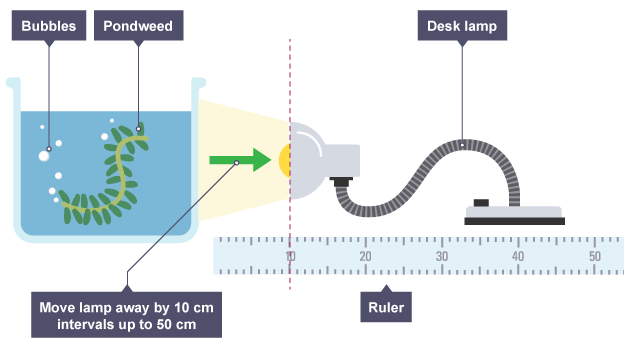
2.22: Describe Experiments to Investigate Photosynthesis, Showing the Evolution of Oxygen from a Water Plant, the Production of Starch and the Requirements of Light, Carbon Dioxide and Chlorophyll

EXPERIMENT:

INVESTIGATING PHOTOSYNTHESIS
Pond Weed in Water                    Variable: Light
METHOD:

  • Set up the Apparatus as in the Diagram
  • Change Variable
  • Leave for 5 Minutes to allow the Pond Weed to adapt to environment
  • Count number of Bubbles Given Off in One Minute
  • Increase or Decrease the Variable (E.g, distance of lamp)
  • Repeat
  • Experiment Other variables

VARIABLES:

LIGHT
  • Use a Lamp and Vary the Distance of the Lamp to the Pondweed to Control the Light Intensity

CARBON DIOXIDE
  • Add Sodium Hydroxide to Absorb and Remove all Carbon Dioxide
  • Add Sodium Bicarbonate to Increase Carbon Dioxide

CHLOROPHYLL
  • Use Variegated Plant (White Plant and Green Plant)

2.21: Understand that Plants require Mineral Ions for Growth and that Magnesium Ions are needed for Chlorophyll and Nitrate Ions are needed for Amino Acids

MINERAL IONS:

MINERAL ION
FUNCTION
MAGNESIUM
Magnesium is needed to Build Chlorophyll
DEFICIENCY: Causes Leaves to turn Yellow
NITRATE
Nitrates are need to produce Amino Acids to Build Protein and DNA
DEFICIENCY: Causes Leaves to turn Yellow and Stunted Growth

2.23: Understand that a Balanced Diet Includes appropriate Proportions of Carbohydrate, Protein, Lipid, Vitamins, Minerals, Water and Dietary Fibre

IMPORTANCE:

  • Humans need to Eat a Balanced Diet to Maintain a Good Health
  • Each Component of the Diet is Important for different reasons, it is important to consume equal amounts of all

 s

IMPORTANT DIETS CONSIST OF:

DIET
CARBOHYDRATE
LIPIDS
WATER
PROTEIN
DIETARY FIBRE

VITAMINS
MINERALS

2.25: Understand that Energy Requirements vary with Activity Levels, Age and Pregnancy

FACTORS THAT AFFECT ENERGY REQUIREMENTS:

FACTOR
EXPLANATION
AGE
The Amount of Energy requirements that Young People need increases towards adulthood as this energy is needed for growth. E.g, Muscle development
ACTIVITY LEVELS
The More Active you are, the more Energy you will require to keep your body moving E.g, If you Exercise, More Muscle Contractions, More Respirations, More Energy Required
PREGNANCY

During Pregnancy, the Energy Requirements will increase as Energy is needed to support the growth of the developing fetus, as well as the Larger Mass that the Mother needs to carry around, Requiring More Energy. E.g, It is important for Mothers to consume Protein for the Growth and Repair of the baby

2.24: Identify Sources and Describe Functions of Carbohydrate, Protein, Lipid (Fats and Oils), Vitamins A, C and D, and the Mineral Ions Calcium and Iron, Water and Dietary Fibre as Components of the Diet

DIET
FUNCTION
CARBOHYDRATE
Direct Energy
SOURCE: Meat, Starch
PROTEIN
Growth and Repair
DEFICIENCY: Marasmus - Poor Growth
SOURCE: Meat
VITAMIN A
Healthy Eyesight
DEFICIENCY: Night Blindness
SOURCE: Carrots
VITAMIN C
Heal Wounds and Rebuild Tissue
DEFICIENCY: Scurvy - Bleeding Gums
SOURCE: Lemon
VITAMIN D
Strengthen Teeth and Bones
DEFICIENCY: Rickets - Curvature of Bones
SOURCE: Margarine
LIPID
Insulation and Energy Storage
SOURCE: Meat
DIETARY FIBRE
Lower Cholesterol
DEFICIENCY: Constipation
SOURCE: Vegetables
CALCIUM
Strengthen Teeth and Bones
DEFICIENCY: Rickets - Curvature of Bones
SOURCE: Milk
IRON
Promote Haemoglobin
DEFICIENCY: Anaemia - Poor Oxygen Transport
SOURCE: Meat
WATER
Chemical Reactions to take place
SOURCE: Water