Showing posts with label j) Coordination and Response. Show all posts

Saturday, June 24, 2017

2.77: Understand that Organisms are able to Respond to Changes in their Environment

SENSITIVITY IN ORGANISMS:

  • Organisms are Able to Respond to Changes in Environment (Stimuli) for Survival
  • The Nervous System allows the Body to Respond to Changes in the Environment and is Coordinated by the Brain
  • Organisms can also have Reflexes which are Fast Involuntary Actions that Protect their Body from Damage


FACTORS NEEDED TO RESPOND TO ENVIRONMENT:

FACTOR
EXPLANATION
STIMULI
Change in Environment
RECEPTOR
Specialised Cells that Detects Change in the Environment
E.g, Sensory Neurones in the Finger will Detect Heat
EFFECTOR
Part of the Body that Produces the Response
E.g Muscles in the Finger that Contract to Pull the Finger Away from the Heat

2.78: Understand that Homeostasis is the Maintenance of a Constant Internal Environment and that Body Water Content and Body Temperature are Both Examples of Homeostasis

HOMEOSTASIS: Maintenance of a Constant Internal Environment

EXAMPLES OF HOMEOSTASIS:

   1. OSMOREGULATION: Controlling Water Content in the Body

   Diagram
                                     
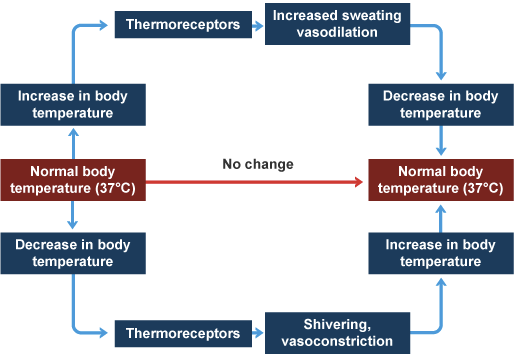
Diagram Showing the Response to Abnormal Levels of Water in the Blood


 2. THERMOREGULATION: Control of a Optimum Temperature for the Body (Allows   
 Enzymes to Work at Optimum Environment)
Diagram:
Diagram Showing the Response to Abnormal Temperatures in the Body (Sweat is One of Many ways the Body Adapts to Regulate Temperature

2.79: Understand that a Coordinated Response Requires a Stimulus, a Receptor and an Effector

COORDINATED RESPONSE: The Process Involved in the Response to a Change in Stimuli (Change in Environment)

Diagram:


DEFINITIONS:

FACTOR
EXPLANATION
STIMULI
Change in Environment
RECEPTOR
Specialised Cells that Detects Change in the Environment
E.g, Sensory Neurones in the Finger will Detect Heat
EFFECTOR
Part of the Body that Produces the Response
E.g Muscles in the Finger that Contract to Pull the Finger Away from the Heat

2.80: Understand that Plants Respond to Stimuli

PLANTS AND STIMULI:

  • Plants are Able to Respond to Changes in Environment (Stimuli) for Survival, E.g Abiotic Factors Such as Light, Water and and Biotic Factors such as Predators
  • They will Respond to Stimuli by Producing a Growth Hormone called Auxin which Controls the Direction of Growth of Roots or Stems


TYPES OF STIMULI:

STIMULI
NAME OF RESPONSE
GRAVITY
Geotropism
LIGHT
Phototropism
WATER
Hydrotropism

2.81: Describe the Geotropic Responses to Stimuli

GEOTROPIC RESPONSE: Growth in Response to the Direction of Gravity

AUXINS: Plant Hormone Produced in the Stem Tips and Roots, which Controls the Direction of Growth

  • Auxin is Produced at the Tip of Stems and Roots and Changes the Elasticity of Cells (More Elastic will Absorb More Water and therefore Grow Longer, Causing Bending in the Stem or Root)
  • Factors such as Gravity can Interfere the Transport of Auxin Causing it to be Unevenly Distributed, Causing a Geotropic Response


GEOTROPIC RESPONSES OF PLANTS:

ROOTS
STEM
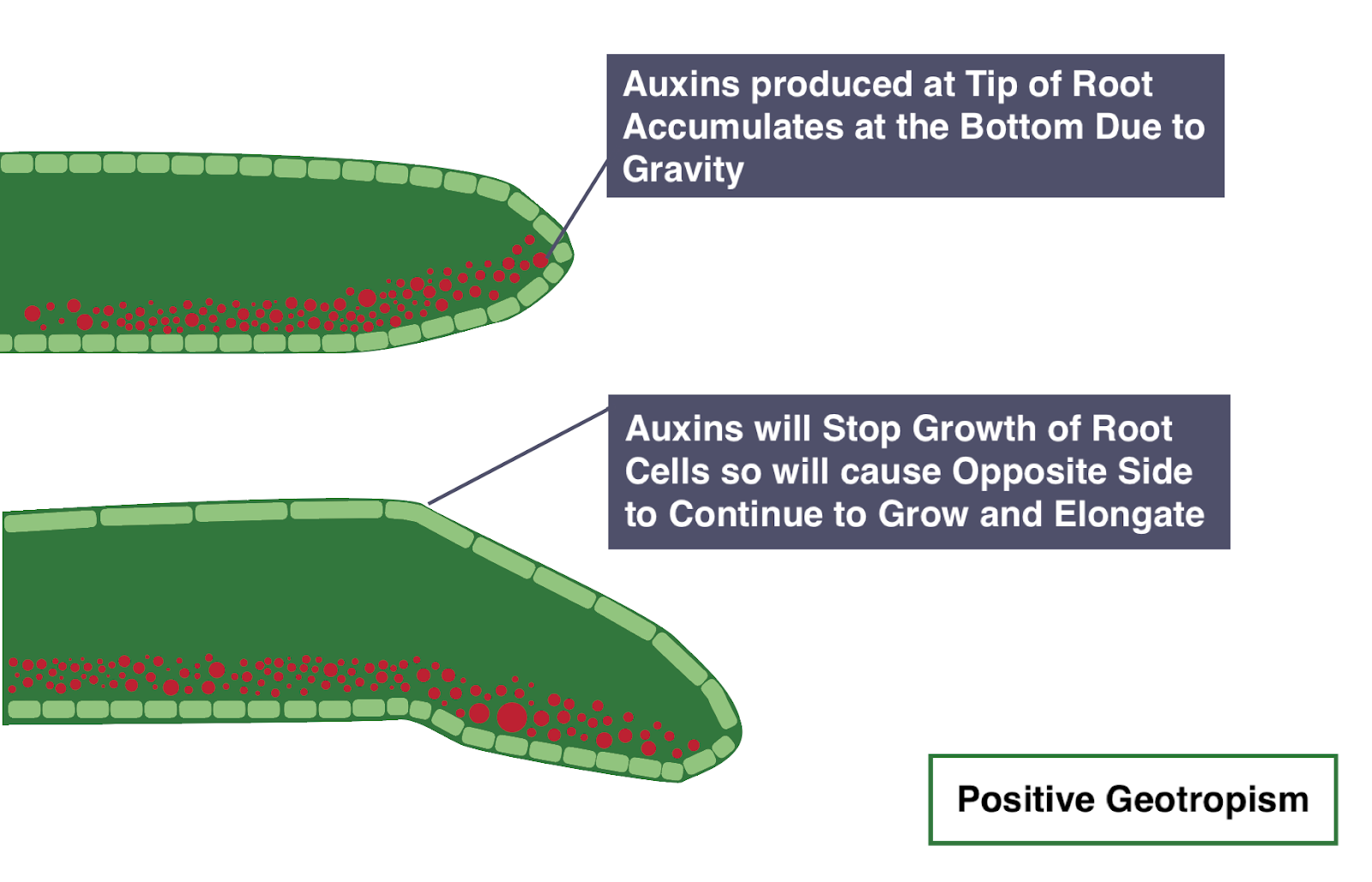
Diagram Showing Positive Geotropism caused by Auxins in the Roots
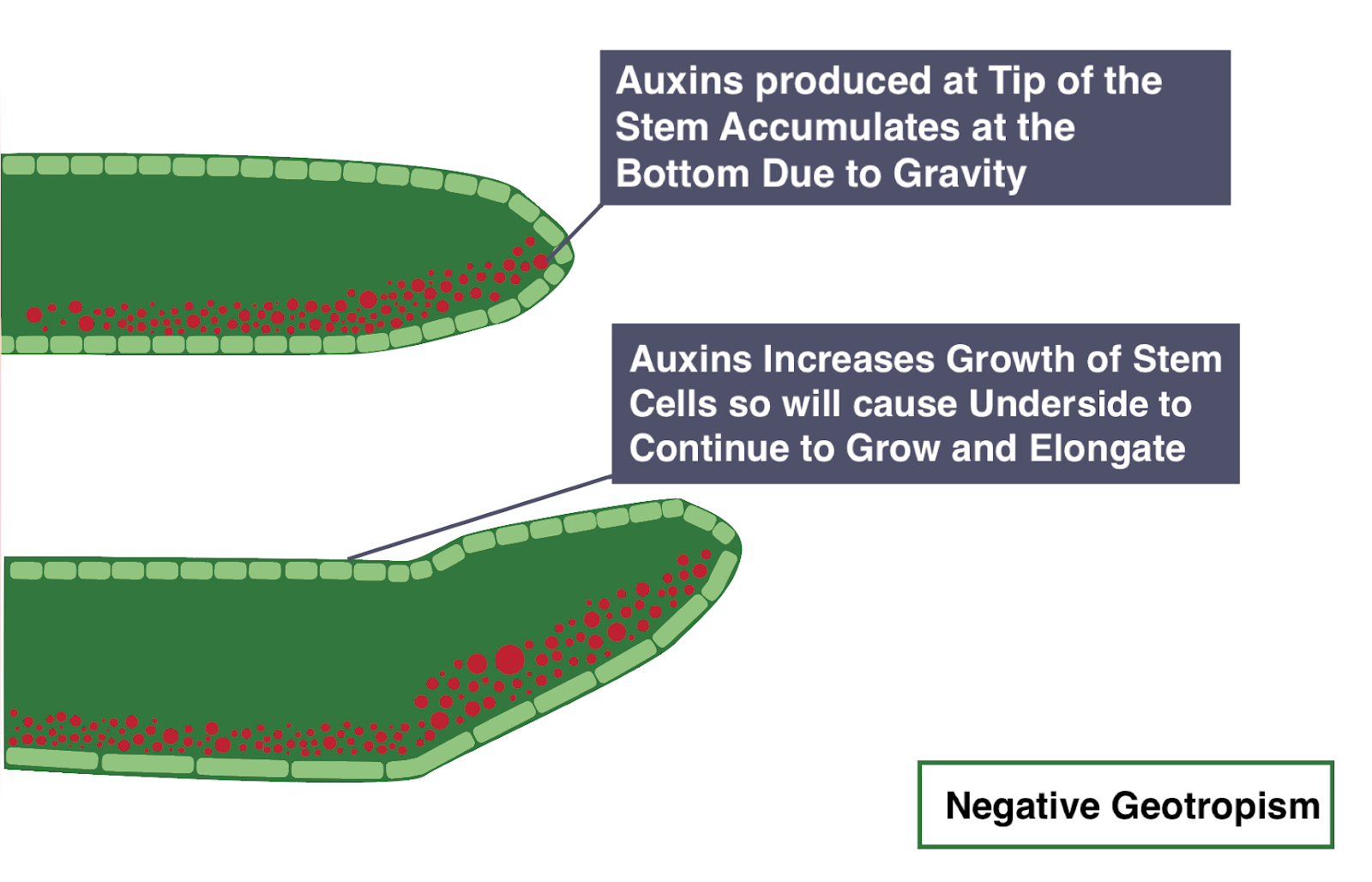
Diagram Showing Negative Geotropism caused by Auxins in the Stem
*Auxins Stops Growth in Root Cells

  • When Roots Grow Sideways, Auxins Produced at the Tip of the Roots will Accumulate on the Underside (Bottom) due to Gravity
  • Auxins Inhibits the Growth of Root Cells so will cause the Underside to Stop Growing
  • Upper Side (Opposite Side) Will continue to Grow Longer and Elongate
  • Roots will Grow Downwards Towards the Direction of Gravity, Allowing Positive Geotropism

*Auxins Increases Growth in Stem Cells

  • When Stems Grow Sideways, Auxins Produced at the Tip of the Stem will Accumulate on the Underside (Bottom) due to Gravity
  • Auxins Stimulates the Growth of Stem Cells so will cause the Underside to Grow Longer and Elongate
  • Underside will Grow Upwards Against the Direction of Gravity, Allowing Negative Geotropism

2.82: Describe Positive Phototropism of Stems

PHOTOTROPIC RESPONSE: Growth in Response to the Direction of Light

AUXINS: Plant Hormone Produced in the Stem Tips and Roots, which Controls the Direction of Growth

  • Auxin is Produced at the Tip of Stems and Roots and Changes the Elasticity of Cells (More Elastic will Absorb More Water and therefore Grow Longer, Causing Bending in the Stem or Root)
  • Factors such as Gravity can Interfere the Transport of Auxin Causing it to be Unevenly Distributed, Causing a Phototropic Response

POSITIVE PHOTOTROPISM OF PLANTS:

POSITIVE PHOTOTROPISM IN STEMS
Diagram showing Positive Phototropism Caused by Auxins in the Stems
PROCESS:

  • Auxins will be Produced at the Tip of the Stem
  • As the Unshaded Side of the Stem is Exposed to the Light, Light will Destroy Auxins on the Unshaded Side
  • The Shaded Side will still have Auxins as it is Not Exposed to Light and Auxins will Stimulate the Growth of Stem Cells so will cause Cells on the Shaded Side to Grow Longer and Elongate
  • The Stem will Bend Towards the Light, Allowing Positive Phototropism to Absorb More Light for Photosynthesis

2.84: Understand that the Central Nervous System consists of the Brain and Spinal Cord and is Linked to Sense Organs by Nerve

CENTRAL NERVOUS SYSTEM: Consists of the Brain and the Spinal Cord and is Linked to Sense Organs by Nerves and Neurons

CENTRAL NERVOUS SYSTEM
 
 Diagram showing the Central Nervous System
PROCESS:
  • The Central Nervous System Decides the Response for a Stimulus which is Detected by a Receptor
  • Sensory Neurons will Carry these Messages (Impulses) to the Central Nervous System (Brain and Spinal Cord) to be Passed on to the Effector by Motor Neurons
  • Effector will Carry Out the Response

2.83: Describe How Responses can be Controlled by Nervous or Hormonal Communication and Understand the Differences Between the Two Systems

NERVOUS COMMUNICATION: Nervous System that is Comprised of a Network of Nerve Cells that Carry Impulses Between Parts of the Body

HORMONAL COMMUNICATION: Endocrine System where Glands Produce Hormones that Stimulates Change in the Body

NERVOUS COMMUNICATION
HORMONAL COMMUNICATION
Diagram Showing the Nervous System
Diagram Showing the Endocrine System
  • Stimulation of Receptors in Sense Organs Sends Electrical Impulses
  • Messages are Carried by Electrical Impulses Along Nerves and Neurons
  • Fast Impulses
  • Short - Lived

  • Endocrine Glands Produce Hormones
  • Hormones are Carried by the Plasma to Target Organs to Stimulate Change
  • Slow as it is Carried by Plasma
  • Long - Lived
SIMILARITIES:

  • Chemicals Involved
  • Requires Stimuli, Receptor and Effector

DIFFERENCES:

  • Nervous Communication is Faster, Hormonal Communication is Slower
  • Nervous Communication is Electrical, Hormonal Communication is Chemical
  • Nervous Communication is Short - Lived, Hormonal Communication is Long - Lived

2.86: Describe the Structure and Functioning of a Simple Reflex Arc Illustrated by the Withdrawal of a Finger from a hot Object

REFLEX: Fast and Involuntary Action that Protects the Body from Damage

REFLEX ARC:

WITHDRAWAL OF A FINGER FROM A HOT OBJECT
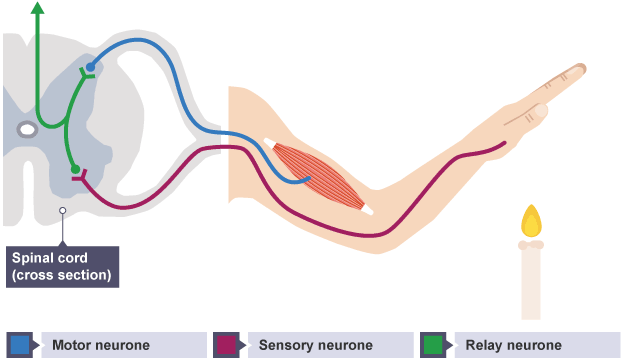
Diagram showing the Reflex Arc in Response to a Hot Object
PROCESS:
  • Heat (Stimuli) is Detected by the Finger (Receptor) and will Stimulate Sensory Neurons to Carry Electrical Impulses (Messages) to the Central Nervous System (Brain and Spinal Cord)
  • Electrical Impulses will be Passed on to Relay Neurons which will Carry Impulses Through the Central Nervous System where a Response is Decided and is Passed on to the Motor Neurone
  • Motor Neurons will Carry Electrical Impulses to the Biceps (Effector)
  • Biceps (Effector) will Contract and will Withdraw the Finger Away from the Hot Object (Response)

2.85: Understand that Stimulation of Receptors in the Sense Organs Sends Electrical Impulses Along Nerves Into and Out of the Central Nervous System, Resulting in Rapid Responses

HOW RAPID RESPONSES ARE CREATED:

RAPID RESPONSES
Diagram showing the Process of Rapid Responses
PROCESS:
  • Stimuli is Detected by Receptors and will Stimulate Sensory Neurons to Send Electrical Impulses to the Central Nervous System (Brain and Spinal Cord)
  • Central Nervous System will Pass On Impulses to the Relay Neurons Across the Synapse (Gap) by Chemicals
  • The Relay Neurons will Pass on Impulses to the Motor Neurons which is Carried to the Effector
  • The Effector will Carry out the Response Quickly, Allowing Rapid Responses

2.88: Understand the Function of the Eye in Focusing Near and Distant Objects, and in Responding to Changes in Light Intensity

NEAR AND DISTANT OBJECTS:

NEAR OBJECT
DISTANT OBJECT
Diagram Showing the Eye when Object is Near
Diagram Showing the Eye when Object is Far
  • Incoming Light is Divergent
  • Ciliary Muscles will Contract, Suspensory Ligaments will Slack
  • This Allows Lens to Become Fatter, Light is Refracted More
  • Light Converges on Retina

  • Incoming Light is Parallel
  • Ciliary Muscles Relax, Suspensory Ligaments will Stretch
  • This Allows Lens to Become Thinner, Light is Refracted Less
  • Light Converges on Retina

OBJECT
CILIARY MUSCLES
SUSPENSORY LIGAMENTS
MUSCLE TENSION ON LENS
LENS SHAPE
NEAR
Contracted
Slackened
Low
Fat, More Curved
DISTANT
Relaxed
Stretched
High
Thin, Less Curved


DARK AND BRIGHT ENVIRONMENT:

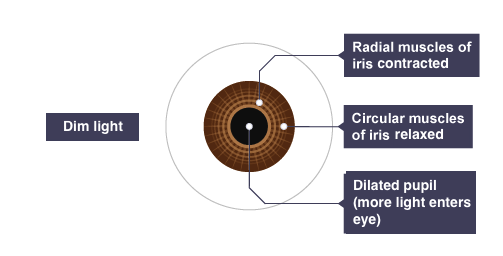
DARK
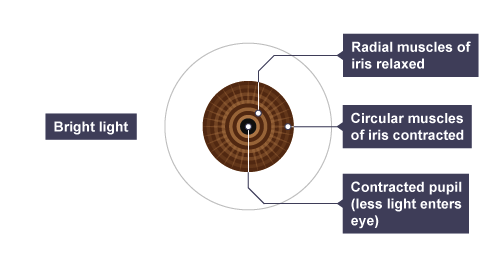
BRIGHT
Diagram Showing the Eye in a Dark Environment
Diagram Showing the Eye in a Bright Environment
  • Photoreceptors Detect Change in Environment (Dark)
  • Reflex Occurs, Muscle in Iris are Effectors: Radial Muscles will Contract, Circular Muscles will Relax
  • Pupil Dilates, Diameter of Pupil Widens and More Light Enters the Eye

  • Photoreceptors Detect Change in Environment (Bright)
  • Reflex Occurs, Muscle in Iris are Effectors: Radial Muscles will Relax, Circular Muscles will Contract
  • Pupil Constricts, Diameter of Pupil Narrows and Less Light Enters the Eye

ENVIRONMENT
RADIAL MUSCLES
CIRCULAR MUSCLES
PUPIL SIZE
AMOUNT OF LIGHT ENTERS
DARK
Contracted
Relaxed
Wide
More
BRIGHT
Relaxed
Contracted
Narrow
Less